5EGB Explorer Guide NW SOUTH AMERICA · EQUATOR 0°00′00″

Explore Ecuador: From the Ocean to the Andes

Welcome to our Ecuador study guide! We will read short, clear English sentences together. We will explore beaches, islands, snowy mountains, and green rainforests.

MADE FOR 5EGB ENGLISH LEARNERS NO ACCOUNT NEEDED

Read one step at a time! Every section teaches key words in English and Spanish (español). Click any ES button whenever you want Spanish help. You never need to type your name or age.

¡Bienvenido/a! Esta guía está pensada para estudiantes de 5.º de EGB que están aprendiendo inglés. Usa el botón ES arriba o en cada pregunta para ver ayuda en español.

Location (Ubicación)
Northwestern South America
Capital (Capital)
Quito (in the Andes)
4 Regions (4 Regiones)
Coast · Inter-Andean · Amazon · Galápagos
Highest Peak in Ecuador
Mount Chimborazo (6,263 m / 20,548 ft)
ES Spanish Help: Overview & Key Words / Resumen y palabras clave

Ecuador en América del Sur: Ecuador está en el noroeste de América del Sur (Northwestern South America). La línea del ecuador (Equator) pasa por el país. Su capital es Quito.

Las 4 regiones: 1. Coast (La Costa, junto al océano Pacífico al oeste), 2. Inter-Andean / Sierra (La Sierra o Región Interandina, en las montañas de los Andes al centro), 3. Amazon (La Amazonía, selva tropical al este) y 4. Galápagos / Insular (grupo de islas volcánicas en el océano Pacífico).

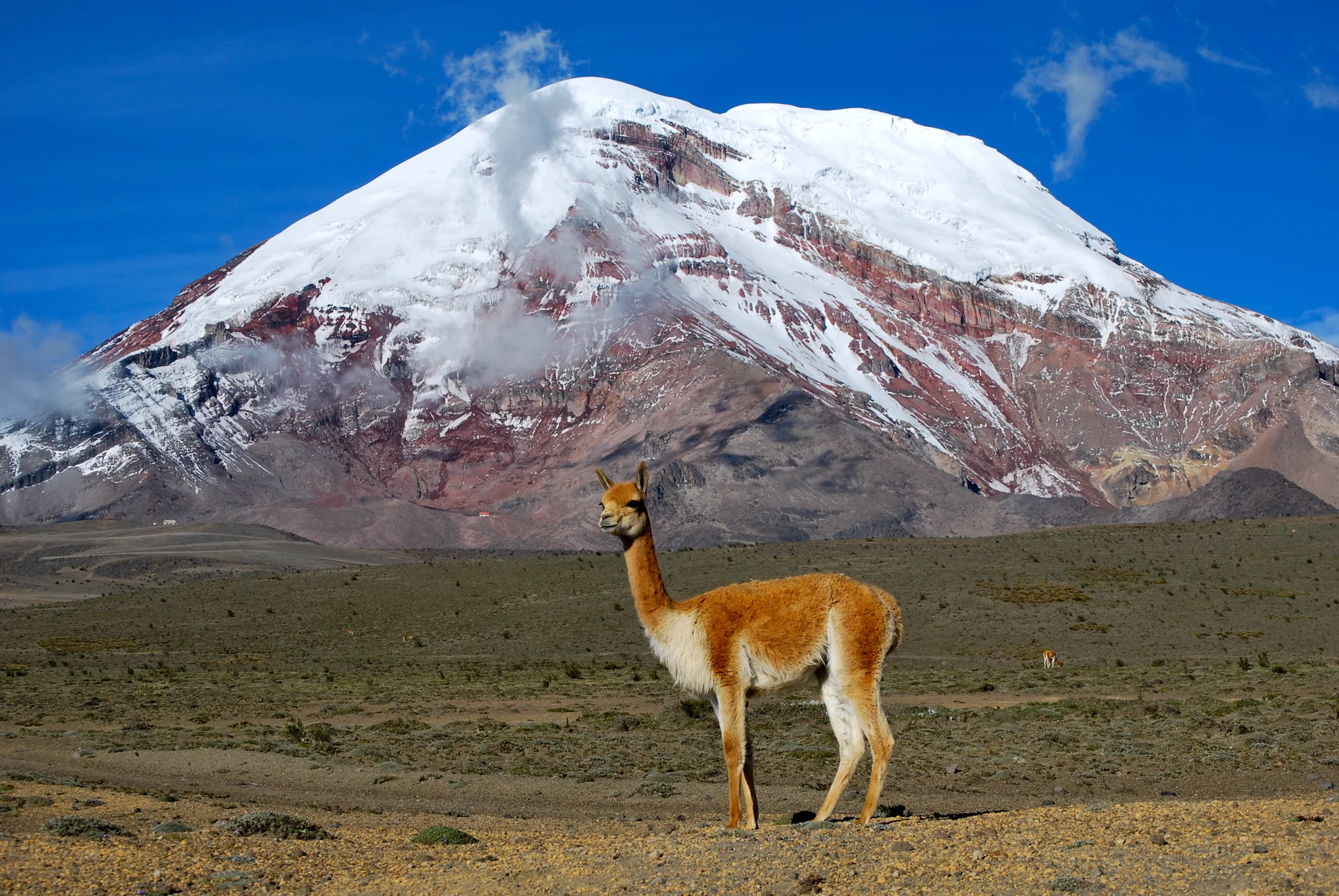
A wild vicuña grazing on mountain grass with snowy Mount Chimborazo behind it.
Field Photo I: A wild vicuña (Vicugna vicugna) eats high mountain grass (páramo) in front of snowy Mount Chimborazo in Ecuador.
Photograph: David Torres Costales · Licensed under CC BY-SA 3.0 via Wikimedia Commons (resized and converted to WebP).
VOCAB Word help / Palabras — Key English & Spanish Words (Palabras clave)

Read key English science and geography words with short meanings and Spanish translations (palabras clave en inglés y español). Click to open anytime!

Geographic Directions (Puntos cardinales)

  • North (norte): Toward the top of the map.
  • South (sur): Toward the bottom of the map.
  • East (este): Toward the right side of the map (where the sun rises; the Amazon).
  • West (oeste): Toward the left side of the map (where the Pacific Ocean and coast are).

Core Vocabulary (Palabras obligatorias)

country (país)
A nation with its own land and government (like Ecuador).
capital (capital)
The main city where a country's government works (Quito in Ecuador).
coast (costa)
Land right next to the ocean.
island (isla)
Land surrounded by water on all sides (like Galápagos).
mountain (montaña)
Very tall land rising high above the ground around it.
valley (valle)
Low land between mountains or hills.
highlands (tierras altas / Sierra)
High areas of land between mountains (like páramo grasslands).
peak (cima / cumbre)
The very highest point of a mountain.
sea level (nivel del mar)
The starting height (0 meters) where ocean water meets land.
erupt (erupcionar)
When a volcano shoots out hot lava, ash, or gases.
lava (lava)
Hot melted rock flowing outside on Earth's surface.
magma (magma)
Hot melted rock stored deep underground.
crater (cráter)
The bowl-shaped opening at the top of a volcano.
main vent (conducto principal)
The main pipe carrying magma upward to the crater.
side vent (conducto secundario)
An opening on the side slope of a volcano where lava or gas can exit.
ash (ceniza)
Tiny bits of crushed rock and volcanic glass thrown into the air.
active (activo)
A volcano erupting now or showing signs of activity.
dormant (durmiente)
A quiet volcano that may erupt again in the future.
extinct (extinto)
A volcano that scientists do not expect to erupt again.
earthquake (terremoto / sismo)
Shaking of the ground caused by rocks slipping underground.
wildfire (incendio forestal)
A large, fast-moving fire burning grass, bushes, or forests.
drought (sequía)
A long time with very little or no rain.
tsunami (tsunami)
Giant ocean waves caused by sudden water movement (like an underwater quake).
tornado (tornado)
A violently spinning column of wind reaching from a cloud to the ground.
CHAPTER 01 MAPS & 4 REGIONS

Find Ecuador & Its 4 Regions

Ecuador is in northwestern South America, next to the Pacific Ocean. Its capital city is Quito. Ecuador has four natural regions: Coast, Inter-Andean (Sierra), Amazon, and Galápagos.

IMPORTANT TIP
Four regions, not five: Inter-Andean, La Sierra, and Highlands are different names for the same central mountain region! (Interandina y Sierra son una sola región central.)
MAP A · SOUTH AMERICA

Where Ecuador Is in South America

Map of South America showing Ecuador in the northwest South America map with the Equator line and Ecuador highlighted in the northwest with capital Quito.

Click Ecuador (ECU) in the upper-left (northwest) corner of South America.

MAP B · ECUADOR & GALÁPAGOS

The 4 Regions, Capital Quito & Chimborazo

Map of Ecuador with Galápagos Islands box and four region markers Map of Ecuador and Galápagos Islands showing Quito, Mount Chimborazo, and four region markers.

Map Symbols (Símbolos del mapa):

  • ★ Quito: Capital city in the Andes
  • ▲ Mount Chimborazo: Highest mountain in Ecuador (6,263 m)
  • ● 1 Coast (La Costa): Warm western land by the ocean
  • ▲ 2 Inter-Andean (La Sierra): Central Andes mountains
  • ◆ 3 Amazon (La Amazonía): Eastern rainforest and rivers
  • ⬡ 4 Galápagos (Insular): Volcanic island group (~1,000 km west)

Map note: Numbers 1–4 show helpful study points, not exact region borders. The Galápagos box is a zoom box for islands far out in the Pacific Ocean (~1,000 km west). Source: Natural Earth (Public Domain).

SELECTED PLACE: ALL OF ECUADOR 01°28′N TO 05°00′S · 75°15′W TO 91°40′W

Ecuador in Northwestern South America

República del Ecuador — Cuatro Regiones Naturales y Capital Quito

Ecuador is in northwestern South America next to the Pacific Ocean. The Equator line crosses right through the country. Its capital city is Quito. Ecuador has four natural regions: Coast, Inter-Andean (Sierra), Amazon, and Galápagos.

En español: Ecuador está en el noroeste de América del Sur. Su capital es Quito y tiene cuatro regiones naturales: La Costa (oeste), La Sierra o Región Interandina (centro andino), La Amazonía (este) y Galápagos o Región Insular (islas en el océano Pacífico).
Where It Is (Ubicación)
Northwestern South America, on the Equator
Landforms (Relieve)
Beaches, Andes mountains and valleys, rainforest, volcanic islands
Weather (Clima)
Warm on the coast and rainforest; cool high up in the mountains
Key Fact to Remember (Dato clave)
Capital: Quito · 4 Regions: Coast, Inter-Andean (Sierra), Amazon, Galápagos

Meet the 4 Regions of Ecuador (Las 4 regiones del Ecuador)

REGION 01 · WEST

Coast (La Costa)

The Coast is in the west, next to the Pacific Ocean. It has warm beaches, flat land for farming, and port cities like Guayaquil.

En español: Está al oeste junto al océano Pacífico. Tiene playas cálidas, tierras bajas y puertos.

REGION 02 · CENTER

Inter-Andean (La Sierra / Andes)

The Inter-Andean region (also called La Sierra) runs down the middle of Ecuador. It has the tall Andes Mountains, green valleys, our capital city Quito, and snowy volcanoes like Chimborazo.

En español: Es una sola región central (Interandina o Sierra) con la Cordillera de los Andes, valles, volcanes y la capital, Quito.

REGION 03 · EAST

Amazon (La Amazonía / El Oriente)

The Amazon region is in the east, past the Andes Mountains. It has warm, wet rainforests, big rivers, and many kinds of plants and animals.

En español: Está al este de los Andes. Tiene selva tropical húmeda, grandes ríos y mucha vida silvestre.

REGION 04 · PACIFIC OCEAN

Galápagos (Región Insular)

The Galápagos region is a group of volcanic islands in the Pacific Ocean. It sits about 1,000 km west of mainland Ecuador. Giant tortoises and sea lions live here!

En español: Grupo de islas volcánicas (archipiélago) en el océano Pacífico, a unos 1.000 km al oeste del continente.

CHAPTER 02 MOUNTAIN WORDS

The Andes Mountains & Landforms

The Andes Mountains cross the middle of Ecuador. Let's learn four important English words for the land: Andes Mountains, volcanoes, valleys, and highlands.

DIAGRAM 1 · SIDE VIEW OF ECUADOR (WEST TO EAST) SIMPLE TEACHING DRAWING · NOT TO SCALE
Side-view drawing of Ecuador from Pacific Coast across the Andes to the Amazon Side-view profile showing land elevation from Pacific Coast across the Andes Mountains to the Amazon rainforest. 6,263 m (20,548 ft) — Chimborazo Peak Highlands (High land between mountains) 0 m — Sea Level (Pacific Ocean) GALÁPAGOS ~1,000 km W 1. COAST West by ocean CHIMBORAZO (VOLCANO) VALLEYS & HIGHLANDS Between mountains 2. ANDES MOUNTAINS Inter-Andean / Sierra 3. AMAZON East rainforest

Side-View Key (West to East / De oeste a este):

  • 1. Coast (La Costa): Low, warm land next to the Pacific Ocean in the west.
  • Mount Chimborazo (6,263 m): A giant volcano and the highest mountain in Ecuador.
  • Valleys & Highlands (Valles y tierras altas): Low valleys and high flat lands between mountains. Quito is here!
  • 2. Andes Mountains (La Sierra): A long chain of mountains. Not every mountain is a volcano!
  • 3. Amazon (La Amazonía): Warm rainforest and big rivers in the east.
Simple Side-View Drawing: Travel from the western Pacific Coast up into the Andes Mountains, across valleys and highlands, and down to the eastern Amazon rainforest.
WORD 01 · MOUNTAIN CHAIN

Andes Mountains (Cordillera de los Andes)

Class Meaning: “Large mountain ranges.”

The Andes are a very long chain of mountains in South America. Many volcanoes stand in the Andes, but not every mountain is a volcano!

ESExplicación en español

Cordillera de los Andes: Gran cadena de montañas que cruza el centro del Ecuador. Tiene muchos volcanes, pero no todas las montañas son volcanes.

WORD 02 · OPENING IN EARTH'S CRUST

Volcanoes (Volcanes)

Class Meaning: “Openings in the Earth's crust that can release lava.”

A volcano is an opening in Earth's outer rock layer (crust = corteza terrestre). Hot melted rock (lava), ash, rock pieces, and gases can come out and build a mountain.

ESExplicación en español

Volcanes: Aberturas en la corteza de la Tierra por donde pueden salir lava, ceniza, rocas y gases, formando una montaña a su alrededor.

WORD 03 · LOW LAND BETWEEN PEAKS

Valleys (Valles)

Class Meaning: “Low areas between mountains.”

A valley is low land between hills or mountains. Rivers often flow through valleys. Cities like Quito sit in mountain valleys.

ESExplicación en español

Valles (Valleys): Terrenos bajos ubicados entre montañas o colinas, por donde suelen pasar ríos.

WORD 04 · HIGH LAND AREAS

Highlands (Tierras Altas / Páramo)

Class Meaning: “High areas between mountains.”

Highlands are wide areas of high land between mountains, like cool mountain grasslands (páramo). They are wide high areas, not just one sharp mountain top.

ESExplicación en español

Tierras altas (Highlands): Zonas amplias de terreno elevado entre las montañas (como los páramos y mesetas andinas), no una sola cumbre aislada.

CHAPTER 03 READING & SCIENCE FACTS

Reading: The Giant Chimborazo

First, read the story about Ecuador's tallest mountain in English. Next, check the three science boxes to see how scientists measure and watch Chimborazo today!

CLASSROOM READING ENGLISH TEXT + SPANISH HELP

The Giant Chimborazo

Chimborazo is a giant volcano in Ecuador. In our class reading, it is 6,263 meters (20,548 feet) high! It is the highest mountain in all of Ecuador.

Earth is wider at the equator. Chimborazo is near the equator. Its top (peak = cima) is farthest from Earth's center. Everest is highest above sea level.

How did Chimborazo get its name? People are not 100% sure, so the exact meaning is uncertain. Our class reading shares one local story. “Chimbu” might mean “on the other side.” “Razor” or “ruco” might mean “ice” or “snow.” In that story, the name is like saying “the mountain of ice.”

Chimborazo is covered in white snow and ice. Cute, fluffy Andean animals called vicuñas live on its high slopes.

A quiet volcano can erupt again. Quiet does not mean safe.

ES Leer la lectura en español / Read Passage in Spanish

El gigante Chimborazo: El Chimborazo es un volcán gigante en el Ecuador. Según la lectura de clase, mide 6.263 metros (20.548 pies) de altura. ¡Es la montaña más alta de todo el Ecuador!

Récord de la cima: La Tierra es más ancha en el ecuador. El Chimborazo está cerca del ecuador. Su cima es la más alejada del centro de la Tierra. El Everest es el más alto sobre el nivel del mar.

El origen de su nombre (incierto): La gente no está 100 % segura del origen de su nombre. La lectura cuenta una historia local donde «Chimbu» podría significar «del otro lado» y «razor» o «ruco» podría significar «hielo» o «nieve», como decir «la montaña de hielo».

Nieve y vicuñas: Está cubierto de nieve blanca y hielo. En sus laderas altas viven las vicuñas.

Seguridad volcánica: Un volcán tranquilo puede volver a erupcionar. Que esté tranquilo no significa que sea seguro.

TEACHER Teacher & Source Details / Notas para docentes y fuentes

Original classroom reading wording: The original classroom handout stated: “Today, the volcano is inactive, which means it is safe and will not erupt.”

Why this was adapted for science: In volcanology, dormant volcanoes are quiet but not extinct. The Instituto Geofísico (IG-EPN) monitors Chimborazo as potentially active. Inactive does not mean guaranteed safe. A quiet volcano can erupt again.

Elevation and name origin notes: The height 6,263 meters (20,548 feet) comes from the class reading. The etymology breakdown with “Chimbu” and “razor” / “ruco” is taught as a traditional local story from the passage, while noting that linguistic scholars consider the true name origin uncertain.

En español: El aviso escolar original decía: «Today, the volcano is inactive, which means it is safe and will not erupt.» En ciencias, el IG-EPN clasifica al Chimborazo como potencialmente activo; estar tranquilo hoy no garantiza seguridad futura. Mantenemos los 6.263 m del texto escolar y el relato del nombre como historia tradicional de origen incierto.

DIAGRAM 2 · EARTH'S CENTER VS. SEA LEVEL (NOAA / IG-EPN) SIMPLE TEACHING DRAWING · NOT TO SCALE
Diagram comparing distance from Earth's center and height above sea level for Mount Chimborazo and Mount Everest Diagram showing Earth wider at the equator, placing Chimborazo's peak farther from Earth's center than Mount Everest. EARTH'S CENTER EQUATOR (WIDER MIDDLE) MOUNT EVEREST Highest above sea level Closer to Earth's center CHIMBORAZO (ECUADOR) Class height: 6,263 m (20,548 ft) FARTHEST FROM EARTH'S CENTER Note: Simple teaching drawing (not to scale). Earth's wider middle is drawn bigger so it is easy to see.

Compare Chimborazo and Everest (Comparación)

How We Measure Mount Chimborazo (Ecuador) Mount Everest (Asia)
Height Above Sea Level (Sobre el nivel del mar) 6,263 m (20,548 ft) Highest mountain in Ecuador (class reading) Highest mountain World's highest above sea level
Distance from Earth's Center (Desde el centro de la Tierra) Farthest peak World's farthest from Earth's center Closer to center Closer to Earth's center than Chimborazo
Where It Sits Right near the Equator (where Earth is wider) Far north of the Equator
CHAPTER 04 VOLCANO STATES & 6 PARTS

Ecuador, a Volcanic Country: States & 6 Parts

First, learn the three volcano states: active, dormant, and extinct. Next, click the 6 volcano parts to explore inside a volcano!

STATE 01 · ACTIVE

Active (Volcán Activo)

Class Meaning: “When the volcano has activity, lava, ash, etc.”

What Scientists Look For: An active volcano is erupting right now, or it shows clear signs of activity inside, such as hot gases or small volcano earthquakes. Cotopaxi, Sangay, and Reventador are active volcanoes in Ecuador.

En español: Un volcán activo está en erupción o muestra señales de actividad (como gases, ceniza o sismos volcánicos).

STATE 02 · DORMANT / POTENTIALLY ACTIVE

Dormant (Durmiente / Potencialmente Activo)

Class Meaning: “When the volcano may erupt in the future.”

What Scientists Look For: A dormant volcano is quiet right now, but it still has heat and can erupt again in the future. Remember: being quiet does NOT guarantee safety! Scientists call Mount Chimborazo potentially active.

En español: Está tranquilo ahora, pero puede volver a erupcionar en el futuro. ¡Estar tranquilo no significa que sea 100 % seguro! El Chimborazo está en este grupo.

STATE 03 · EXTINCT

Extinct (Volcán Extinto)

Class Meaning: “When the volcano won't erupt in the future.”

What Scientists Look For: Based on rock evidence, an extinct volcano has no more supply of hot melted rock (magma) below it. Scientists do not expect it to erupt again based on evidence.

En español: Según las pruebas científicas, ya no tiene suministro de magma y no se espera que vuelva a erupcionar.

WARM-UP GUESS · NEVER GRADED

Quick Guess: Magma vs. Lava (¿Magma o Lava?)

Both magma and lava are super-hot melted rock! Click one guess below to see the difference. Your guess does not change your score.

TEACHING MODEL — SCHEMATIC DRAWING (NOT TO SCALE) This model shows how a volcano works inside. It is not Chimborazo's real inside.
Inside diagram of a volcano showing six parts Cutaway diagram showing underground magma, central vent, crater, side vent, surface lava flow, and ash cloud. OUTSIDE GROUND LEVEL UNDERGROUND ROCK CRUST 5. ASH (Ceniza Volcánica) 2. CRATER (Cráter) 1. LAVA (Outside Flow) 4. CENTRAL VENT (Main Pipe) 6. SIDE VENT (Side Exit) 3. MAGMA (Underground)

Interactive model ready

STEP 2 — CLICK ANY BUTTON TO LEARN A PART

6 Parts of a Volcano (6 partes del volcán)

PART 01 OF 06 · OUTSIDE SURFACE

Lava (Lava)

Meaning: Hot melted rock that comes out of a volcano onto Earth's outside surface. It flows down the side and cools into solid rock.

Remember: Underground it is called magma. Once it comes outside onto the ground, it is called lava!

En español: Roca derretida muy caliente que ya salió a la superficie exterior y baja por la ladera del volcán.

See All 6 Volcano Parts Together (Click to open / Ver las 6 partes)

1. Lava (Lava)

Where it is: Outside the volcano, flowing on the ground.

What it is: Hot melted rock that came out of a volcano opening. When it cools, it turns into hard rock.

2. Crater (Cráter)

Where it is: At the very top of the volcano.

What it is: A bowl-shaped opening at the top of the volcano around the main central vent (not a giant collapsed basin, and not the underground pipe).

3. Magma (Magma)

Where it is: Deep underground, below Earth's surface.

What it is: Super-hot melted rock and gas stored in underground rock spaces before an eruption.

4. Central Vent (Abertura y conducto central)

Where it is: Up the middle of the volcano.

What it is: The main pipe going up and the top opening where magma, ash, and gas come out.

5. Ash (Ceniza volcánica)

Where it is: Blasted high into the sky during an eruption.

What it is: Tiny sharp pieces of crushed rock and volcanic glass. It is not soft smoke from burning wood!

6. Side Vent (Abertura lateral)

Where it is: Opening on the side slope (flank) of the volcano.

What it is: A side branch pipe that breaks through the side of the volcano so lava or gas can exit from the side, not only from the top.

CHAPTER 05 5 NATURAL DISASTERS

Natural Disasters & Staying Safe

Learn the five natural disasters from your study list: earthquake, wildfire, drought, tsunami, and tornado.

SAFETY TIP
Always listen to trusted adults: Learning about Earth helps us stay calm and ready. In a real emergency, always follow your family, teachers, and local safety helpers.
DISASTER 01 · SHAKING GROUND

Earthquake (Terremoto / Sismo)

Meaning: A sudden shaking of the ground. It happens when underground rocks slip along a crack (called a fault = falla).

Remember: Earthquakes happen underground in rock, not from rain clouds!

How to stay safe
Safety step: Indoors, Drop, Cover under a strong table or desk, and Hold On away from glass windows.

En español: Sacudida repentina del suelo cuando se mueven las rocas bajo tierra. Bajo techo: Agacharse, Cubrirse y Sujetarse lejos de ventanas.

DISASTER 02 · SPREADING FIRE

Wildfire (Incendio Forestal)

Meaning: An unplanned fire that spreads fast through dry grass, bushes, or forest trees.

Remember: Hot, dry, and windy weather helps wildfires spread quickly.

How to stay safe
Safety step: Never play with fire. Leave the area right away with a trusted adult if safety helpers tell you to evacuate.

En español: Fuego sin control que se extiende por bosques, matorrales o pasto seco.

DISASTER 03 · TOO LITTLE WATER

Drought (Sequía)

Meaning: A very long time (weeks, months, or years) with too little water and much less rain than normal. It dries the soil and hurts plants, animals, and people.

Remember: One sunny afternoon without rain is normal weather, not a drought!

How to stay safe
Safety step: Save water every day and protect mountain plants (páramo) that store clean water.

En español: Largo período con muy poca lluvia y falta de agua que afecta a plantas, animales y personas. ¡Una sola tarde soleada no es sequía!

DISASTER 04 · BIG OCEAN WAVES

Tsunami (Tsunami / Maremoto)

Meaning: A series of large ocean waves caused when a huge amount of ocean water is pushed suddenly, often by an underwater earthquake.

Remember: A tsunami is many waves arriving over time, not just one wave or normal daily tides.

How to stay safe
Safety step: If the beach shakes strongly or ocean water pulls back fast, walk quickly uphill to high ground right away!

En español: Serie de grandes olas en el océano causadas por un movimiento brusco del agua (como un sismo submarino). En la costa, sube rápido a zonas altas.

DISASTER 05 · SPINNING STORM WIND

Tornado (Tornado)

Meaning: A fast, violently spinning column of wind that reaches from a thunderstorm cloud all the way down to the ground.

Remember: A small dust swirl on a sunny day is not a tornado. A tornado connects to a thunderstorm cloud.

How to stay safe
Safety step: Go to a basement or an inside room on the lowest floor, far away from windows.

En español: Columna de viento que gira con mucha fuerza desde una nube de tormenta hasta tocar el suelo.

CHAPTER 07 PRACTICE · 30 QUESTIONS

Practice Your 30 Questions

Answer one question at a time! Need help with English words? Review our Word help / Palabras vocabulary guide, or click Help in Spanish / Ayuda en español on any question to read questions, choices, and key words in Spanish without losing points.

QUESTIONS COMPLETED
0 / 30 (Saved in this browser only · You can retry anytime!)